After a collision, most vehicle owners want the same two things: a car that looks right and a repair they can count on. What is less obvious is that the shop you choose directly affects both of those outcomes, including whether your manufacturer’s warranty stays intact and whether the safety systems built into your vehicle continue to work correctly.
Certified auto body repair shops follow documented standards that govern how a vehicle is repaired at every stage. These standards are set by vehicle manufacturers and independent industry organizations, and they exist because modern vehicles are complex systems where a deviation in one area affects performance in another. Falk Auto Body and Glass Inc has provided auto body repair in Red Wing, MN, and across southeastern Minnesota since 1958. Every vehicle that comes through our doors goes through a documented repair process because a repair that only looks correct is not the same as a repair that is correct.
What Shop Certification Actually Covers
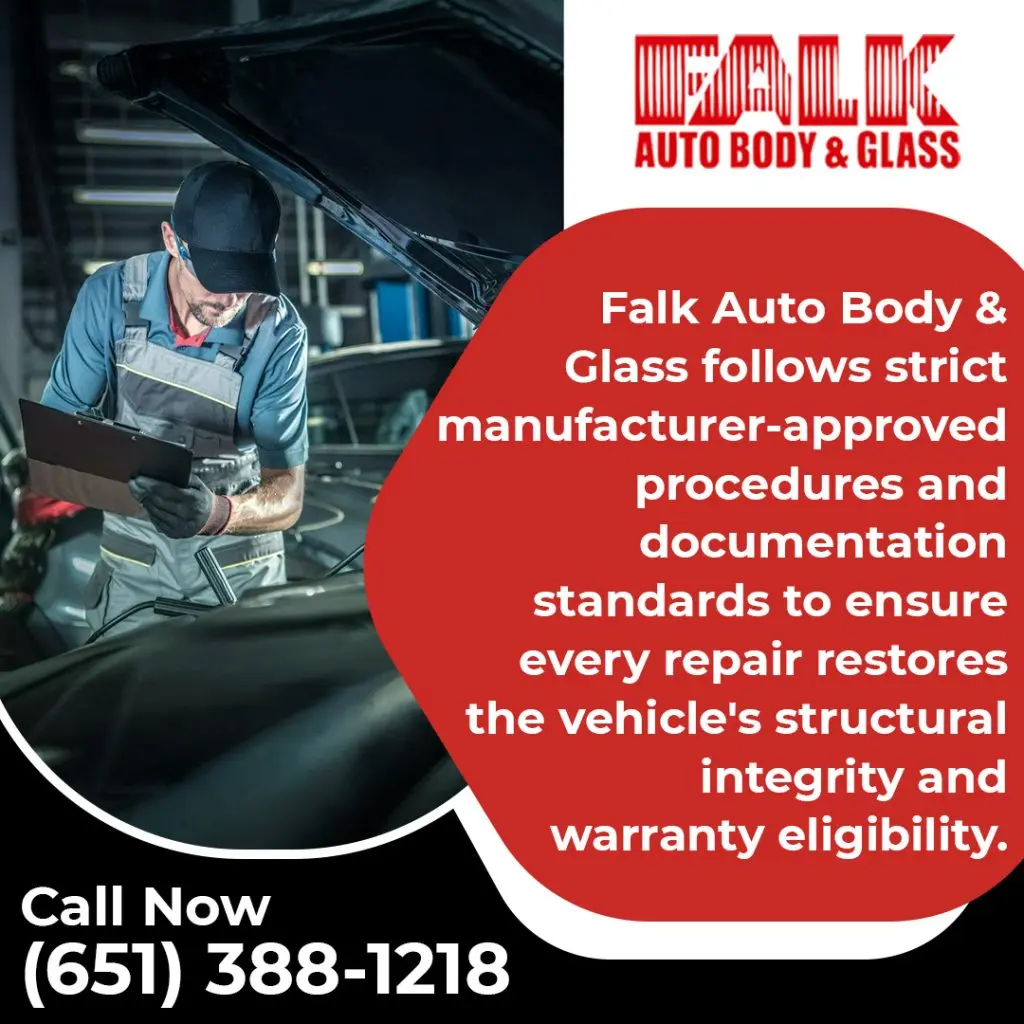
Certification in auto body repair tells you that a shop has met verified standards for training, equipment, and repair procedures before working on your vehicle.
Industry Training and Technician Certifications
Two independent organizations set the primary training and competency standards for collision repair shops and technicians.
I-CAR (Inter-Industry Conference on Auto Collision Repair) issues Gold Class certification to shops that meet industry-wide training requirements and maintain them through annual renewal. A Gold Class shop stays current with changes in vehicle materials, safety systems, and repair procedures as manufacturers introduce them.
ASE (National Institute for Automotive Service Excellence) certifies individual technicians in collision repair disciplines, including structural analysis and damage repair, non-structural panel work, and refinishing. Technicians must pass a written exam and demonstrate hands-on experience to earn each credential. Recertification is required every five years.
These credentials reflect a shop’s commitment to current repair standards at both the facility level and the individual technician level.
Manufacturer Program Approvals
Vehicle manufacturers run their own approval programs for collision repair facilities. These programs require shops to meet brand-specific equipment, tooling, and training criteria before approval is granted. An OEM-approved shop is verified by that manufacturer to perform repairs according to their documented standards, using approved procedures and parts.
A shop holding both industry certifications and manufacturer program approvals has met standards verified at two independent levels. That combination is a reliable indicator that the shop is equipped to restore your vehicle the way the manufacturer intended.
How the Repair Choice Affects Your Manufacturer Warranty
A collision repair performed outside of manufacturer-documented procedures can give the vehicle’s manufacturer documented grounds to deny warranty claims on affected systems.
Vehicle manufacturers publish OEM (Original Equipment Manufacturer) repair procedures for each specific make, model, and year. OEM stands for Original Equipment Manufacturer. These procedures define exactly how each component must be repaired or replaced, covering welding techniques, adhesive types, torque values, temperature limits, and part selection requirements.
Warranty exposure after a collision repair comes down to three areas: parts selection, repair procedure compliance, and calibration documentation.
Parts Selection and Warranty Risk
Using aftermarket parts on structural or safety-related components creates warranty risk when those parts perform differently from OEM specifications. Under the Magnuson-Moss Warranty Act, a manufacturer cannot void an entire warranty simply because an aftermarket part was used. However, if that part directly causes or contributes to a failure, the manufacturer can deny coverage for the affected system.
Repair Procedure Compliance
Auto body repairs performed outside of manufacturer-documented procedures carry the same risk. If a structural component is repaired using a technique not specified for that material or vehicle, and a related failure occurs within the warranty period, the deviation from procedure becomes the manufacturer’s documented basis for denial.
Calibration Documentation
Calibration records carry equal weight. Any sensor repositioned during a repair and not recalibrated leaves a gap in the repair documentation. If the connected safety system fails within the warranty period, the absence of calibration records is evidence of an incomplete repair.
In all cases, the finished vehicle may show no visible signs of the issue. The documentation, or the lack of it, determines the warranty outcome. This is why choosing a certified auto body repair service that follows manufacturer procedures and provides complete records on every repair directly affects your warranty protection.
Effect of a Collision on Vehicle Safety Systems
A collision that shifts a sensor by only a few millimeters can cause a safety system to report inaccurate data with no dashboard warning to alert the driver.
Modern vehicles are built with ADAS (Advanced Driver Assistance Systems) integrated throughout the exterior. ADAS refers to the electronic safety features that detect obstacles, monitor lane position, and alert drivers to hazards. These systems rely on radar, camera, and sonar sensors embedded in bumpers, windshields, and body panels.
Any repair affecting those surfaces can displace sensor positions. When a sensor is no longer in its factory-calibrated location, the system continues to function. The data it sends to the vehicle’s safety control modules, however, is no longer accurate. There is no warning light that tells the driver something is wrong.
According to the Insurance Institute for Highway Safety (IIHS), vehicles with front automatic emergency braking experience 50% fewer rear-end collisions than vehicles without it. That statistic applies only when the system is working correctly. A displaced, uncalibrated sensor removes that protection without any signal to the driver.
ADAS Recalibration After a Collision Repair
ADAS recalibration restores sensor accuracy to factory specifications. Manufacturer procedures require it whenever a bumper assembly, windshield, or sensor-bearing panel is affected during a repair.
Recalibration is not a single uniform process. It takes two forms, and many vehicles require both.
Static Calibration
Static calibration is performed inside the shop. The vehicle is placed on a level surface, and specialized targets are positioned at manufacturer-specified distances and angles from each sensor. The process is completed before the vehicle moves.
Dynamic Calibration
Dynamic calibration requires a test drive under defined road conditions. Sensors reestablish accurate detection data as the vehicle moves through real traffic. The conditions of the test drive, speed, road type, and distance, are specified by the manufacturer for each sensor type.
Completing only one form of calibration when both are required leaves certain safety systems operating on data that does not reflect the sensor’s corrected position. When searching for auto body repair near you, confirming that both forms of calibration are performed as standard practice is a direct measure of repair quality.
Repair Sequence at a Certified Shop
A certified auto body repair service follows a structured process. Each step must be completed correctly before the next begins. Each step in this sequence directly affects whether your vehicle’s warranty coverage holds and whether its safety systems perform correctly after the repair is complete.
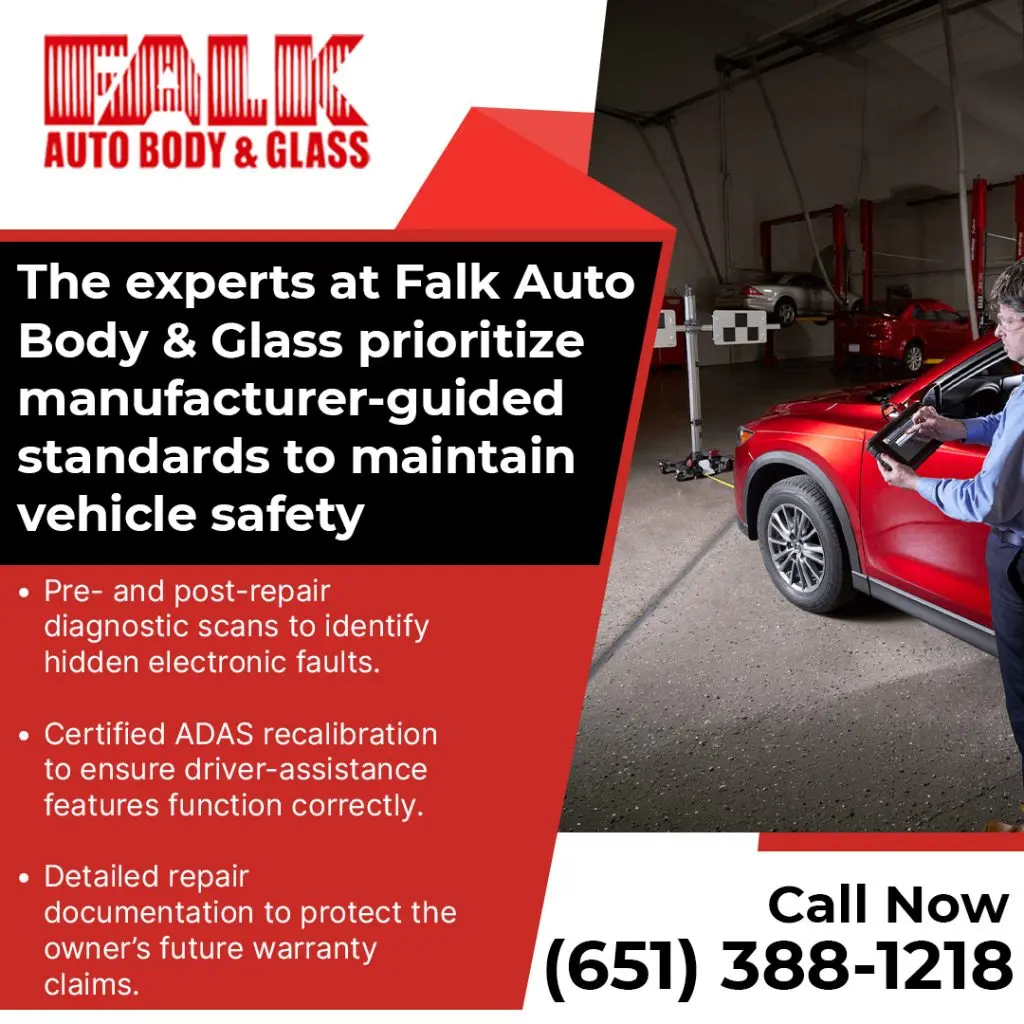
Pre-Repair Diagnostic Scanning
Before any physical work begins, a full diagnostic scan identifies all electronic systems affected by the collision. Modern vehicles store fault codes throughout their computer networks after an impact, including in systems with no visible external damage. A rear bumper impact, for example, can generate fault codes in the airbag control module, the ADAS control module, and the body control module simultaneously. The scan establishes a documented baseline that is used to verify all systems at the end of the repair.
Disassembly and Damage Assessment
Removing damaged exterior components gives technicians direct access to the underlying structure. Surface damage consistently conceals issues that cannot be detected from the outside.
A cracked bumper cover can hide a bent bumper beam, fractured energy absorbers, and radar sensors that have shifted out of position. A dented trunk lid can reveal a buckled trunk floor and misaligned hinges once removed. A full damage assessment requires disassembly. A visual inspection alone is not sufficient.
Structural Repair Per Manufacturer Specifications
Each repair step follows the documented procedure for the exact year, make, and model being serviced. Manufacturers revise these procedures as new materials and designs are introduced. A procedure published for a 2021 model may not apply to the 2024 version of the same vehicle.
Certified auto body repair shops access the current manufacturer procedure databases. Computerized frame measuring systems verify structural geometry at multiple reference points throughout the repair, confirming alignment within manufacturer tolerances.
ADAS Recalibration and Post-Repair Scanning
After structural and panel work is verified, any displaced sensors are recalibrated using manufacturer-specific equipment and targets. A post-repair diagnostic scan confirms all electronic systems communicate correctly and that no fault codes remain. This step catches issues that are not visible during a physical inspection or test drive.
Documentation at Completion
Complete documentation at the close of every repair includes pre-repair and post-repair scan reports, ADAS calibration certificates, and repair photographs. This record is evidence that the work was performed to manufacturer standards. It is also the protection available if a warranty question arises after the vehicle is returned.
At Falk Auto Body & Glass, we follow this documented sequence on every repair, from the initial scan through final documentation, because our auto body repair service is built on doing the work correctly, not just making the vehicle look correct.
What to Verify Before Choosing a Shop
Before leaving your vehicle at any shop, ask the following questions directly:
- What certifications does the shop currently hold?
- Does the shop follow manufacturer repair procedures for the specific year, make, and model?
- Is a diagnostic scan performed before and after every repair?
- Are ADAS sensors recalibrated after repairs that affect bumpers, windshields, or body panels?
- Does the shop provide written documentation at the close of every repair?
- Does the shop provide a written warranty on the repair, and what does it cover?
- Can the shop communicate directly with your insurance carrier on your behalf?
Use these questions to evaluate any auto body repair near you. A certified shop will answer each one directly and back every answer with documented records.
Falk Auto Body & Glass: Red Wing’s Certified Collision Repair Shop
Falk Auto Body & Glass has served drivers in Red Wing, Cannon Falls, Lake City, and across southeastern Minnesota since 1958. Every vehicle is repaired according to the manufacturer’s documented procedures for that specific make, model, and year.
Our facility holds I-CAR Gold Class certification and manufacturer program approvals from Hyundai, Ford, GM, and FCA (Fiat Chrysler Automobiles). We access current manufacturer repair procedure databases and apply updated procedures as they are revised.
Our repair process is built around the following standards:
- Pre-repair and post-repair diagnostic scanning on every vehicle
- Computerized frame measuring systems for structural alignment verification
- ADAS recalibration using manufacturer-specific equipment and targets
- A dedicated aluminum repair area with separate tooling to prevent cross-contamination with steel components
- Complete documentation provided at the close of every repair
- Direct communication with insurance carriers to document required procedures
- A limited lifetime warranty on every repair, valid for as long as you own the vehicle
Drivers choose Falk Auto Body & Glass because every repair is performed to the standard the manufacturer set and documented from the first scan to the last.
Schedule Your Auto Body Repair in Red Wing, MN
Your vehicle’s warranty coverage and the accuracy of its safety systems depend on how the auto body repair is performed, not just how it looks when it is done. Call Falk Auto Body & Glass at (651) 388-1218 or email mike@falkautobody.com to schedule an inspection or discuss your vehicle’s repair. We serve drivers in Red Wing and nearby communities across southeastern Minnesota.
Every repair is performed to manufacturer standards, documented at every stage, and backed by a limited lifetime warranty for as long as you own your vehicle. That is how we protect both the safety your vehicle was designed to deliver and the warranty coverage that came with it.