
Most drivers focus on how the car looks when it comes back from the shop, but the repairs that matter most are the ones you cannot see. The structural components, safety sensors, and electronic systems inside your vehicle all need to be restored to factory specifications after a collision. That process is governed by OEM, or Original Equipment Manufacturer, repair procedures that vehicle manufacturers write to specify exactly how each component should be repaired or replaced.
Falk Auto Body and Glass Inc has been providing auto body repair in Red Wing since 1958, serving families across southeastern Minnesota with a commitment to doing every repair the right way. Our team follows manufacturer-documented procedures on every vehicle we service because a repair that only looks correct is not the same as a repair that is correct. When you search for auto body repair near you, the difference between shops often comes down to this single standard, and it is a standard we hold ourselves to on every job that comes through our doors.
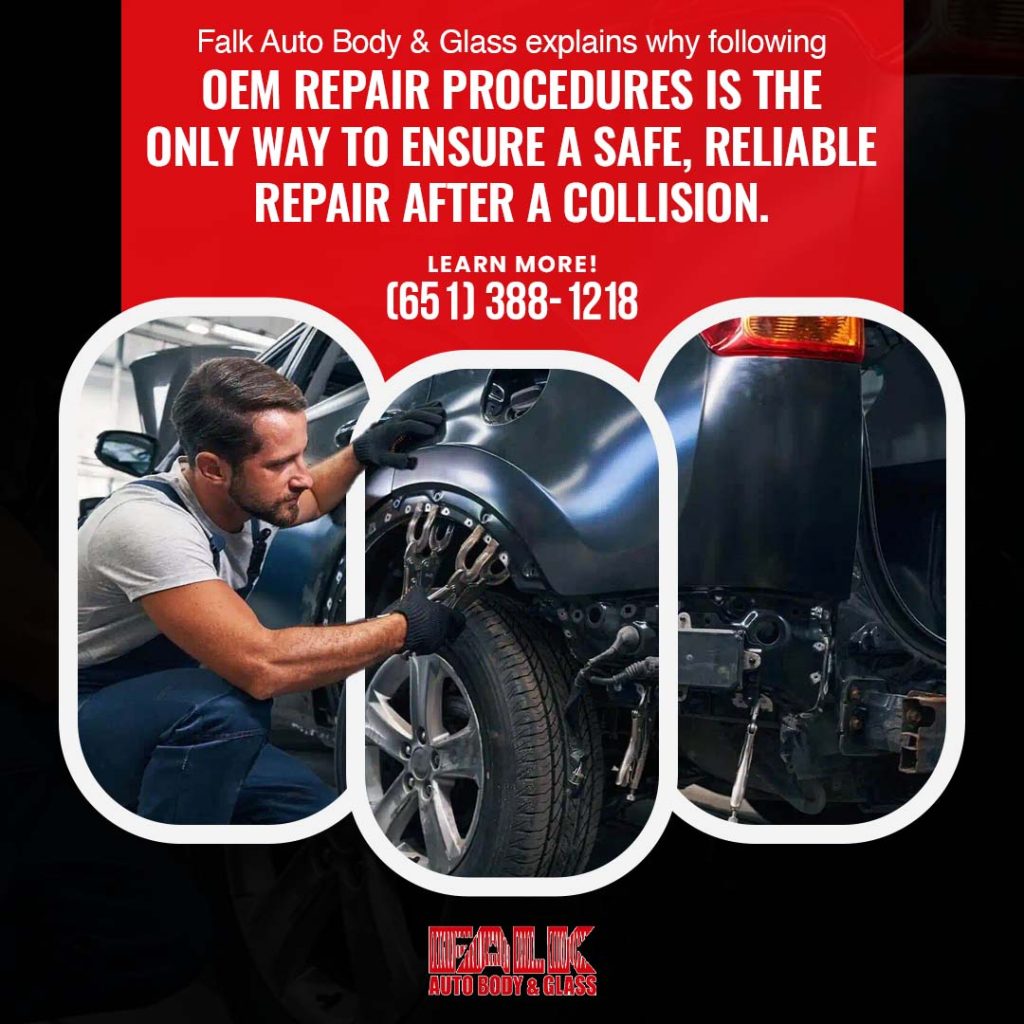
What OEM Repair Procedures Are
OEM stands for Original Equipment Manufacturer. OEM repair procedures are step-by-step instructions written by your vehicle’s manufacturer that specify exactly how each component must be repaired, replaced, or reinforced after a collision.
These are not general best practices. They are model-specific, regularly updated, and tested by the engineers who designed the vehicle. OEM procedures cover areas such as:
- Which structural components can be straightened, versus which must be replaced
- Welding techniques and temperature ranges for specific steel and aluminum grades
- Adhesive types and application methods for bonded panels
- Torque values for fasteners in structural areas
- When and how Advanced Driver Assistance Systems (ADAS) must be recalibrated
ADAS refers to the electronic safety features built into modern vehicles, including automatic emergency braking, lane departure warning, and adaptive cruise control. These systems rely on sensors positioned at precise locations throughout the vehicle’s exterior. Any repair that shifts those sensors affects how the systems perform.
A 2022 Ford F-150 is repaired differently from a 2022 Honda CR-V, even when the visible damage looks identical. As Ford’s Senior Damageability Engineer has stated, following OEM procedures is the only way to have confidence that a repaired vehicle will perform as intended.
Why Modern Vehicles Require This Level of Precision
Modern vehicles use multiple materials and interconnected electronic systems that respond differently to collision forces. This makes repair accuracy more critical than it was on older vehicles.
Structural areas use ultra-high-strength steel (UHSS), which provides strong crash protection but loses its protective properties if heated beyond a specific temperature during repair. Hoods, doors, and outer panels on many models are made from aluminum, which requires completely separate tools, ventilation, and welding techniques. Using steel tools on aluminum causes galvanic corrosion, a chemical reaction between two different metals that develops beneath the surface over time and weakens structural integrity.
Exterior components also house critical electronics. Radar sensors for collision warning systems are embedded in front bumpers. Cameras for lane departure and backup systems are mounted in windshields and rear panels. A minor panel repair or windshield replacement can shift these sensors by just a few millimeters, which is enough to compromise their accuracy if OEM procedures are not followed.
A bumper is a practical example. It may appear to be a cosmetic part, but it is a structural component in your vehicle’s crash management system. The rate at which a bumper compresses during impact triggers the sensors that deploy your airbags. A bumper that does not meet factory specifications can affect airbag deployment timing in ways that increase injury risk.
Consequences of Skipping OEM Procedures
Structural Failure
When repairs deviate from OEM specifications, a vehicle’s structure may not manage crash energy the way it was designed to.
A documented legal case illustrates this directly. A collision shop replaced the roof of a 2010 Honda Fit using adhesive bonding. Honda’s published procedure specifies over 100 spot welds for that repair. When the vehicle was later involved in a front-end collision, the roof failed to absorb crash energy properly. The structural failure caused serious injuries, and a Texas jury awarded over $31.5 million in damages against the shop.
The vehicle had passed visual inspection. It drove normally. Nothing indicated the repair had altered the safety structure until the next collision occurred.
Compromised Safety Systems
Sensors displaced during a repair can cause ADAS features to malfunction without any dashboard warning.
Modern vehicles carry dozens of sensors embedded in bumpers, windshields, and body panels. These sensors govern critical safety functions, including automatic emergency braking, lane departure warning, and blind spot monitoring. When a repair shifts any of these sensors even slightly out of position, the system continues to operate but produces inaccurate readings.
The driver receives no alert that anything is wrong. The safety features appear to be functioning normally, but they are responding to incorrect data. That gap between appearance and reality only becomes apparent when those systems are called upon in an emergency and fail to perform as designed.
Long-Term Material Deterioration
Improper material handling during a repair causes damage that develops gradually, not immediately.
When steel tools contact aluminum components, galvanic corrosion begins beneath the painted surface. It remains invisible until panels are removed, sometimes months or years after the repair. Welds performed outside the specified temperature range develop small fractures that grow under normal driving stress. Structural adhesive applied without proper surface preparation loses bond strength over time. Throughout this process, the vehicle continues to look and drive normally. The deterioration is internal and only becomes visible when structural components are inspected directly.
These are the risks that separate auto body repair shops that follow documented manufacturer procedures from those that do not, and they are risks that affect your safety long after you drive away from the shop.
OEM-Compliant Repair Process
Pre-Repair Diagnostic Scanning
Before any physical work begins, a full diagnostic scan identifies all systems affected by the collision. Modern vehicles store collision data throughout their computer networks. A pre-repair scan reveals fault codes in systems that show no visible damage, including airbag sensors, ADAS modules, and structural monitoring systems. This step is required by most manufacturer procedures and establishes a documented baseline before repairs begin.
Model-Specific Repair Execution
Each repair step follows the documented procedure for the specific year, make, and model being serviced. This means consulting current manufacturer databases, not printed manuals or procedures carried over from previous model years. Manufacturers update procedures regularly as new materials and revised designs are introduced. A procedure written for a 2020 model may not apply to the 2023 version of the same vehicle.
Technicians identify the correct materials, welding sequences, adhesive types, and replacement requirements before work begins. Components that appear repairable may be specified for replacement in the manufacturer’s documentation. That determination is made based on the procedure, not visual assessment alone.
ADAS Recalibration
Any repair affecting bumpers, windshields, hoods, or frame geometry requires ADAS recalibration per manufacturer specifications.
Recalibration takes two forms. Static calibration is performed inside the shop, with the vehicle on a level surface and specialized targets positioned at manufacturer-specified distances and angles. Dynamic calibration requires a test drive under defined conditions, allowing the systems to reestablish accurate environmental data.
Many vehicles require both. Completing only one step leaves some safety systems operating on incorrect data. The Automotive Service Association (ASA) has formally stated that OEM procedures must be researched and applied before, during, and after every repair.
Post-Repair Verification
A post-repair diagnostic scan confirms all systems communicate correctly and no fault codes remain. This verification step catches problems that are not visible during a physical inspection or test drive.
Documentation, including scan reports, calibration certificates, and repair photographs, should be provided to the vehicle owner at completion. This record confirms the repair was performed to manufacturer standards and provides a reference if any concerns arise later. It is also what distinguishes a thorough auto body repair service from one that stops at the surface.
Certifications That Define Quality Auto Body Repair Shops
When a vehicle comes in for collision repair, the decisions made before a single tool is picked up determine whether that repair is truly safe. The shop’s training, equipment, and access to current manufacturer procedures all shape the outcome. Certifications exist to help drivers identify which shops have made that investment.
Industry Certifications and Manufacturer Approvals
Industry certifications provide an objective measure of a shop’s commitment to current repair standards. They require shops to demonstrate competency in specific areas, maintain proper equipment, and keep their training up to date as vehicle technology changes. Manufacturer approvals, such as certifications from GM, Ford, Toyota, or Hyundai, indicate the shop has met equipment and training standards set by that specific brand.
I-CAR Gold Class Certification
I-CAR Gold Class certification is one of the most recognized indicators that a shop follows current OEM procedures. I-CAR, which stands for Inter-Industry Conference on Auto Collision Repair, requires ongoing annual training as vehicle technology evolves. It is renewed each year, meaning the shop stays current with new materials, safety systems, and repair requirements rather than relying on credentials earned years ago.
Evaluating Auto Body Repair Shops
When evaluating auto body repair shops in your area, these are the right questions to ask:
- Do you access OEM procedures for each specific vehicle before repairs begin?
- Do you perform ADAS calibration using manufacturer-specific equipment?
- Do you provide pre-repair and post-repair diagnostic scan documentation?
- What manufacturer certifications does your facility hold?
A shop that follows proper procedures will answer each question directly and offer documentation of its process. The finished appearance of a repair does not confirm that OEM procedures were followed. Documented records of scanning, calibration, and procedure compliance are the evidence that matters.
Asking these questions when searching for auto body repair near you takes only a few minutes and gives you a much clearer picture of whether a shop is equipped to restore your vehicle to the standard it was built to meet.
Putting OEM Repair Procedures Into Practice at Falk Auto Body & Glass
Falk Auto Body & Glass has provided auto body repair in Red Wing and the surrounding communities since 1958. Every vehicle we repair is serviced according to the manufacturer’s documented procedures for that specific make, model, and year.
Our facility holds I-CAR Gold Class certification and manufacturer approvals that include GM, Hyundai, and Chrysler, among others. We maintain current access to manufacturer repair procedure databases and update our methods as procedures are revised.
Our capabilities include:
- Computerized frame measuring systems for structural alignment verification
- On-site ADAS calibration using manufacturer-specific equipment and targets
- A dedicated aluminum repair area with separate tools to prevent cross-contamination
- Pre-repair and post-repair diagnostic scanning on every vehicle
- Direct communication with insurance carriers to document required procedures
Following OEM procedures is not something we do selectively at Falk Auto Body & Glass. It is the standard applied to every vehicle that comes through our doors, regardless of the make, model, or scope of the damage. That consistency is what sets our auto body repair service apart and gives our customers confidence that their vehicle has been properly restored, not just made to look that way.

The Standard That Protects You
OEM repair procedures exist because every component in your vehicle was engineered to work within exact specifications. Deviating from those specifications changes how the vehicle performs in a future collision, even when the repair looks correct from the outside.
The auto body repair service you choose determines whether your vehicle’s safety systems are genuinely restored or only appear to be. Manufacturer procedures, certified technicians, proper materials, and verified calibration work together to produce a repair that holds up when it matters. When you search for auto body repair near you, look for a shop that can back every one of those elements with documentation and certified training.
Call Falk Auto Body & Glass at (651) 388-1218 or email mike@falkautobody.com to discuss your vehicle and how we can help. Drivers in Red Wing and nearby areas of southeastern Minnesota choose Falk Auto Body & Glass because they know every repair will be handled according to the manufacturer’s exact specifications.